
What the Meta Data Centre Could Mean for Your Power Bill
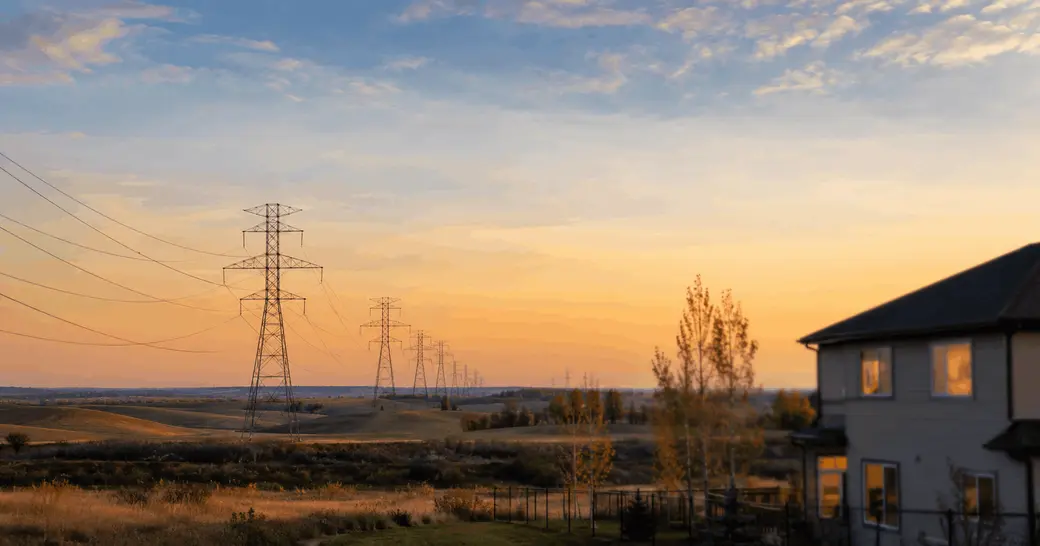
Back in July I wrote about Meta choosing Sturgeon County for its first Canadian data centre, and I was genuinely excited about it. Thirteen billion dollars, thousands of construction jobs, and a global company deciding that the ground north of our city was worth betting on. I stand behind that post.
Since then, a second half of the story has shown up, and it lands a lot closer to the kitchen table. A new analysis says the project could add a few hundred dollars a year to the typical Alberta household power bill. That is a different question than whether the investment is good for the region, and I think it deserves its own look.
I am not going to tell you what to think about this one. There are people with strong opinions on both sides and I am not one of them. What I can do is lay out what has actually been said, who said it, and how I would think about it if I were budgeting for a home right now.
What the new analysis says
In late August, the Pembina Institute, a Canadian energy think tank, released an analysis projecting that the Meta facility could add roughly $270 to $460 a year to the average Alberta household electricity bill between 2027 and 2031. Some coverage of the analysis put the potential increase as high as about 25 percent.
The reasoning goes like this. Alberta ran on natural gas for about 77 percent of its electricity supply in 2025, and in a market like ours, gas plants very often set the price everyone pays. Add a very large new customer to the grid and you tighten the balance between supply and demand, which tends to push wholesale prices up. David Pickup, director of the Pembina Institute's electricity program, described the facility coming online as roughly equivalent to adding a city the size of Calgary to the grid.
The timing gap is the part worth understanding
This is the detail nobody was really talking about in July, and it is the heart of the whole argument.
The site is eventually meant to be powered by its own dedicated natural gas plant. That plant, the 932 megawatt Greenlight facility, is not expected to be running until late 2030. The data centre itself is expected to be operational well before that. So for a stretch of years in between, the facility would be drawing what it needs from the same grid the rest of us are on, without the new generation to match it.
One quick clarification, because the names cause real confusion. The Pembina Institute is the think tank that produced the cost analysis. Pembina Pipeline Corporation is the company building the Greenlight plant. They are two completely separate organizations with almost the same name, and they are on opposite sides of this story.
The numbers being discussed
| Figure | What it refers to |
|---|---|
| $13 billion | Meta's stated investment in the Sturgeon County facility |
| 1 GW, or 1,800 MW | Expected power draw. Meta announced one gigawatt. The Pembina Institute estimates 1,800 MW once completed. I cannot reconcile the two from public sources, so both are here. |
| $270 to $460 a year | Pembina Institute's projected added cost per Alberta household, 2027 to 2031 |
| Up to 6 percent | Province's projected decrease to the transmission portion of consumer bills |
| About $1.50 a month | What the Pembina Institute calculates that 6 percent is worth to an average household |
| Late 2030 | When the dedicated Greenlight gas plant is expected to be online |
What the province and Meta say
Both push back, and their responses are worth reading properly rather than skimming.
Alberta's Ministry of Affordability and Utilities says the analysis conflates wholesale and retail rates, which are not the same thing. Wholesale is what generators get paid in the market. Retail is what shows up on your bill, and the two do not move in lockstep. The ministry also points out that Albertans can opt into a fixed rate and shield themselves from market swings, which is a fair and genuinely practical point.
The province has also said the project will reduce the transmission portion of consumer bills by up to 6 percent, because a very large customer helps pay for the shared grid. Worth noting that the Pembina Institute does not dispute that reduction. It calculates it at roughly $1.50 a month for an average household and argues that it is small next to the market effects it is projecting.
Meta, for its part, says it will cover the full energy costs of the facility and will not pass them on to Alberta residents.
How I would read a number like this
Take it with a grain of salt. There has to be some merit to it, and I am not dismissing it. But people really need to consider the source and do their own homework before forming an opinion, and that goes for every party in this story.
The Pembina Institute is a clean energy organization with a stated position favouring renewables over gas. That does not make its math wrong, and it is transparent about its methodology, but you should know where it is coming from. The province and Meta both have an obvious interest in this project going ahead smoothly, so the same test applies to them. And a projection covering 2027 to 2031 is a forecast, not a measurement. Nobody has a bill in hand yet.
What buyers actually ask me
Here is where this stops being a policy debate and starts being my day job.
Buyers ask me what utilities are going to cost on a given home fairly often. Roughly a third of the time, if I had to put a rough number on it, and it has become a more common question as costs have climbed. People are not asking out of curiosity. They are asking because they need to build a real monthly budget and they do not want a surprise after possession.
It is also a genuinely hard question to answer well. So many things move that number. Square footage, age of the home, insulation, windows, furnace efficiency, whether there is air conditioning, how many people live there, and how warm you like the place in January. Two nearly identical houses on the same street can land in very different places. An average is useful as a starting point and misleading as a promise, so I try not to hand anyone a single figure and call it done.
This is a greater Edmonton area conversation more than a neighbourhood one. The build is in our back yard so the news is relevant here, but a change in provincial electricity prices does not care which part of the region you live in.
What I tell people
Budget yourself appropriately, and build in a buffer.
Utility costs rise and fall. They always have. The specific reason they might move in a given year matters less than whether your budget can absorb it when they do. You do not want to be in a position where an unexpected increase puts you in a tough spot on your bills. That is true whether the cause is a data centre, a cold snap, a gas price spike, or something nobody has thought of yet.
Practically, that means a few things. Ask for actual utility history on a home you are serious about instead of relying on an average. Look at your total monthly carrying cost rather than just the mortgage payment, since heat, power, water, taxes, insurance and condo fees are all part of what you actually pay to live there. Our mortgage calculator is a decent place to start on the financing side, but the real number is always bigger than the payment. And if predictability matters more to you than chasing the lowest possible rate, a fixed electricity rate is worth looking into.
I will say this plainly too. My own bills have gone up over the last few years, like almost everyone's. We are all feeling the pinch. That is not a data centre story, that is an inflation story, and it is worth keeping the two separate in your head.
Where I land
Honestly, in the middle, and I am comfortable there.
I think there will be positive and negative impacts from this project, and I hope the pros outweigh the cons. Edmonton needs businesses that want to build here. Growth is how a region gets more jobs, more people, and more reasons for someone to plant roots instead of passing through. I appreciate that the government is working to bring big business to this province. I also hope they are protecting citizens and the environment to the best of their ability while they do it. Those two things are not in conflict.
As for whether this changes anyone's buying decision, I doubt it will stop many people. It is a headline that could reasonably concern you, and it belongs in your budgeting. It is not, in my view, a reason to sit out the market. There are always people with concerns about a project this size, and some of those concerns turn out to be right. We will know more as this gets built.
Trying to figure out what a home will actually cost you every month?
Happy to walk through the full carrying cost on any place you are considering, utilities included, so there are no surprises after possession. Request a home evaluation or reach me through the contact page whenever you are ready. No pressure to list.
The honest answer today is that we are all working from projections. Read them, weigh who is making them, and build a budget that can handle being wrong in either direction.
Categories
Recent Posts









"My job is to find and attract mastery-based agents to the office, protect the culture, and make sure everyone is happy! "