
Does the Infill Next Door Change What Your Home Is Worth? Edmonton Council Just Ordered a Study
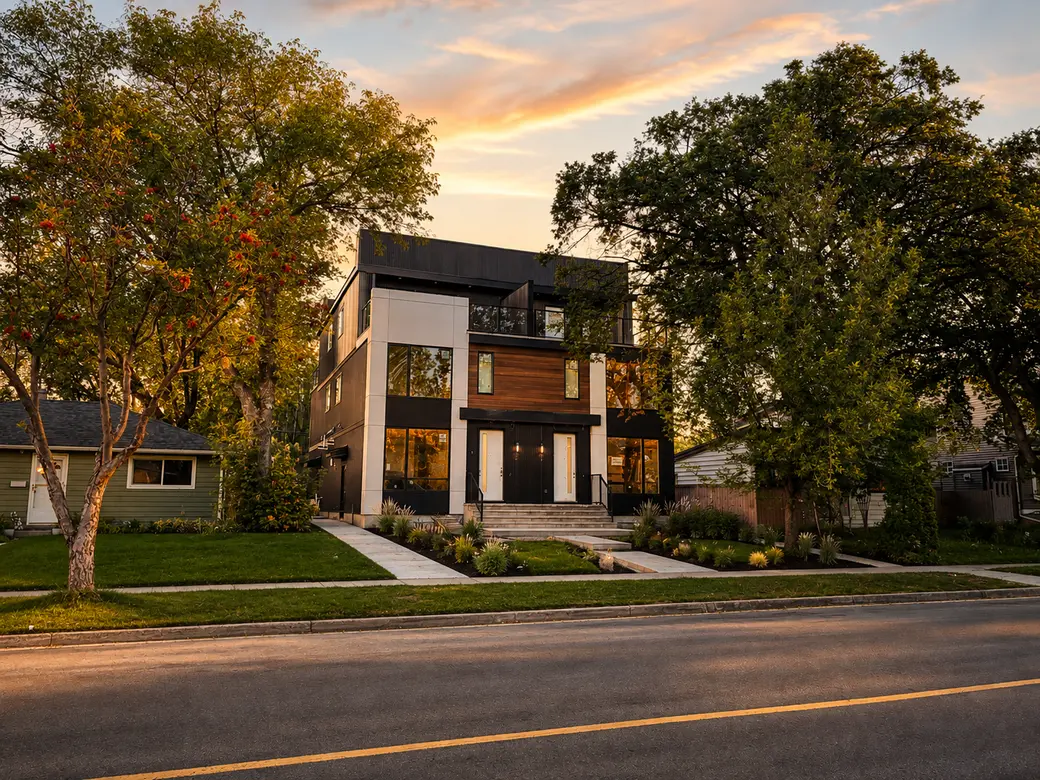
On August 20, Edmonton city council voted 9 to 4 to have administration report back on how infill development affects the property values of surrounding homes in the small scale residential (RS) zone.
Councillor Karen Principe brought the motion forward after hearing from residents worried about two things that sound contradictory but are being raised by the same people. One is that infill might be pulling their property value down. The other is that rising assessments are pushing their property taxes up.
I live in Avonmore, and my own neighbourhood is seeing a lot of this. So is Bonnie Doon next door, and north of the river in Glenora, Westmount and Inglewood, and out west into Britannia Youngstown. Wherever you look in the mature neighbourhoods closer to the core, redevelopment is underway and this conversation is already happening over fences and at block parties. So let's actually go through it, including the parts that don't flatter either side of the argument.
What council actually asked for
The motion is a request for information, not a policy change. Nothing about the RS zone changed on August 20. Administration will study the question and report back.
Four councillors voted against it: Erin Rutherford, Ashley Salvador, Keren Tang and Jo-Anne Wright. Their objection was not that the question doesn't matter. It was that the question may not be answerable.
"I can't support this motion because I think we're giving administration an impossible task," Wright said. "They cannot determine property values have either increased or decreased solely as a result of infill."
She has a point, and it is worth understanding rather than dismissing. A home's value moves with interest rates, migration, inventory, condition, renovations, school catchments, the strength of the local economy and about a dozen other things at once. Isolating the effect of one new building next door from all of that is genuinely hard.
Principe's counter, reported by Global News, was that imperfect information still beats none. "It's nuanced, but it would be nice to see for transparency and to give residents the information they're looking for because there are a lot of concerns."
I land with Principe on this one, and not because I have a prediction about what the report will say. We should be reviewing policies like this to make sure they are still working for the city. If the answer comes back that infill is neutral or positive, that settles a lot of anxiety. If it comes back that certain situations do hurt neighbours, then we know where to focus. Either result is useful.
What I actually see in the field
I'll be straight with you about what my own experience does and does not tell me.
Not one client has ever asked me whether the infill next door is going to hurt their value. Not once. That question is louder online than it is in living rooms.
When I have listed homes beside completed infill, nobody brought it up. Not in showing feedback, not in offers, not in negotiations. The one real world effect I notice after a build is finished is more cars on the street, because more people live on the block than used to.
That is one agent's experience, not a study, which is part of why a real analysis is worth having.
What I do get asked about constantly is the construction itself. That is a separate issue from value, and I'll come back to it, because it is the part I think deserves the most attention.
The other number in the room
Council did not debate this in a vacuum. Two weeks before the vote, on August 4, housing advocate Jacob Dawang of Grow Together Edmonton published an analysis estimating what infill is adding to Edmonton's property tax base.
Here is the short version of what he did, because the number gets thrown around without the method attached.
Dawang took city building permit data from 2024 through the first half of 2026 and matched it against the city's own property assessment records, so he could see what a specific lot was assessed at before redevelopment and what it was assessed at after. He worked at the lot level rather than the permit level so a fourplex and a later garden suite on the same lot wouldn't get double counted.
The important step is that he did not just take the raw before and after difference. Edmonton assessments were rising anyway over that period. So he pulled a control group of roughly 77,000 RS zone properties in mature neighbourhoods that were not redeveloped, found they gained about 19 percent in assessed value over those two years, and subtracted that general appreciation out. What's left is meant to be the redevelopment effect on its own.
| What he measured | The estimate |
|---|---|
| Lots redeveloped, 2024 to mid 2026 | About 1,567 |
| Homes added | About 8,650 |
| Added to the assessment base | About $1.82 billion |
| Extra municipal tax per year | About $14.9 million |
| Or, instead, a property tax rate cut of | About 0.7% |
A few honest caveats. Roughly 9 percent of that $1.82 billion is actually sitting in the 2026 assessment roll today. The rest is a model projecting forward on lots that aren't built or fully assessed yet. Dawang is also an advocate for more housing, and he says so plainly at the bottom of his own post. He is not pretending to be neutral.
That said, he published his data sources, his matching method, his match rates and his adjustments, and anyone can go check his work. That is more transparency than most numbers in this debate come with. Take it as a well documented estimate rather than a final fact.
Here is the piece homeowners should sit with. If infill is expanding the tax base, that is the same mechanism as a rising assessment on the block. Growth in assessed value across the city spreads the levy across more total value. Growth in assessed value on your specific property shifts more of the levy onto you. Both things are true at once, which is exactly why residents can feel like their taxes are going up because of infill while the city's finances improve because of it.
Where infill genuinely could cost a seller
Here is the scenario I think is real, and it doesn't get talked about enough.
If your home is in rough condition, and other tired properties on your street have already sold to builders at land value, that becomes the comparable pool for your home. If those neighbours took low offers to get out quickly, that can absolutely affect what a seller in the same position gets.
I did a CMA in Britannia with a colleague where the seller was frustrated about the infill going up on her street. A builder had been going door to door on the block offering low prices to see who would bite. She turned it down flat, which was the right call for her.
That's the situation that concerns me most, and it isn't really about infill. It's about information. Some owners do not know what their property is worth as a redevelopment site, and a knock on the door with a number attached can feel like a real offer when it may be well under market. Not every builder operates that way, but the ones who do are counting on the homeowner not checking.
If a builder approaches you, talk to a REALTOR before you sign anything. That advice costs you nothing and it is the single easiest way to avoid leaving money on the table.
The parts I think need fixing
I am generally positive on infill. Over time it improves the desirability of a neighbourhood, which supports values. It signals a community that's refreshing rather than sliding backward. And it gives every owner on the block a future option to redevelop that they didn't have before.
But there are three things I would like to see handled better, and none of them are about whether density is good or bad.
Stacking the biggest builds mid block. The RS zone caps an interior lot at 8 dwellings, and requires a minimum of 75 square metres of site area per dwelling. So a builder needs roughly 600 square metres to reach that maximum, which a typical mature neighbourhood lot clears comfortably.
Here is the part most homeowners have not clued into. That 8 unit cap applies per lot, not per original property. A wide lot can be subdivided into two lots, and if each new lot still clears about 600 square metres, each one carries its own 8 unit entitlement. Sixteen homes where one house used to sit.
That takes size to pull off. On a standard lot of about 50 feet by 150 feet, subdividing leaves each half near 350 square metres, which caps out around four units per side. To get the full eight on each half you're looking at an original lot around 90 feet wide at typical depth, or one that's unusually deep. Those lots exist in our mature neighbourhoods, and they are exactly the ones builders are hunting for.
Now add that Edmonton removed minimum parking requirements citywide in 2020, so nothing obligates those units to come with stalls. On a corner lot with two frontages, that density works. Mid block, on a street built for single family homes, the parking and traffic pressure is real. I would rather see the largest builds pushed toward corner lots where the street can absorb them.
Site security on vacant builds. This one is not hypothetical. CBC reported that fires at Edmonton properties classified as under construction or demolition vacant rose 66 percent, with Edmonton Fire Rescue Services responding to 290 such fires between the start of 2022 and the end of 2025, and determining that 154 of them, about 53 percent, were deliberately set. Police have laid charges in a series of infill arsons, and part of the wave has been tied to an organized extortion investigation targeting homebuilders. An empty wood frame structure that catches fire is a threat to the houses on either side of it. Mandatory security and check requirements on vacant sites would be a reasonable ask.
Site conduct. Mud caked across the sidewalk that turns slick in the rain. Garbage blowing around the block. Excavation work that damages a neighbour's fence or yard. These are the complaints I actually hear, and they are the ones that turn neighbours against infill faster than any zoning debate.
What the city is already doing about it
Worth knowing, because most homeowners don't.
Edmonton has had an Infill Compliance Team since April 2016. It monitors infill sites and can issue warnings, tickets and stop work orders. The most common complaints are builders storing materials on the road or boulevard without a permit, or running equipment across the boulevard or sidewalk without permission.
Complaints are climbing sharply. The city's infill compliance dashboard recorded 514 complaints in 2025, up from 196 the year before. City staff attribute that largely to the increased volume of infill being built.
Council has also moved on a Construction Accountability Program that tracks builders who repeatedly fail to meet standards and flags them for high oversight. Measures include mandatory training for high oversight builders, unannounced inspector visits during high risk phases of construction, and higher fees for repeat non compliance. Those are rolling out through late 2026 and into early 2027, with administration reporting back in a year. The 2026 operating budget also reinstates funding for an Infill Liaison Team to field infill related complaints and coordinate between departments.
So the answer to "what is the city doing to hold builders accountable" is: more than it was, with more coming, and there is a formal complaint channel if something is happening on your street right now. If a site near you is a mess or unsafe, report it. The complaint volume is part of what pushed council to strengthen the program in the first place.
What this means if you own in a mature neighbourhood
Nothing has changed today. A report is coming, and it will take months.
In the meantime, here is what I'd tell any homeowner in a mature Edmonton neighbourhood watching this play out on their street.
If you plan to stay put, the construction phase is the part that will actually affect your life, not the finished building. Know that a compliance process exists and use it.
If you're thinking about selling in the next few years, the redevelopment potential of your lot may be a bigger factor in your value than whatever is going up beside you. That cuts in your favour more often than people expect.
And if a builder knocks on your door with a number, do not answer it on the spot.
One thing I've noticed consistently: it isn't the people moving into these neighbourhoods who have the concerns. It's the neighbours who have been here a long time and want to stay in their homes as long as possible. Those concerns deserve a straight answer rather than being talked past, which is a reasonable argument for doing the study even if it comes back imperfect.
Wondering what your home is worth, or what your lot is worth to a builder?
Those are two different numbers, and you should know both before anyone knocks on your door. Request a home evaluation or reach me through the contact page whenever you are ready. No pressure to list.
Infill is reshaping Edmonton's mature neighbourhoods whether we study it or not. Getting real numbers on the table beats arguing from the anecdote that happens to be loudest on your block, and that is worth something no matter which side of this you land on.
Categories
Recent Posts



"My job is to find and attract mastery-based agents to the office, protect the culture, and make sure everyone is happy! "